Battery jobs, from site assessment to sign-off
Domestic retrofit or commercial BESS. Onroute takes the whole battery job in the right order: assessment, DNO consent, install, commissioning and handover. The evidence pack an auditor asks for builds itself as you go.
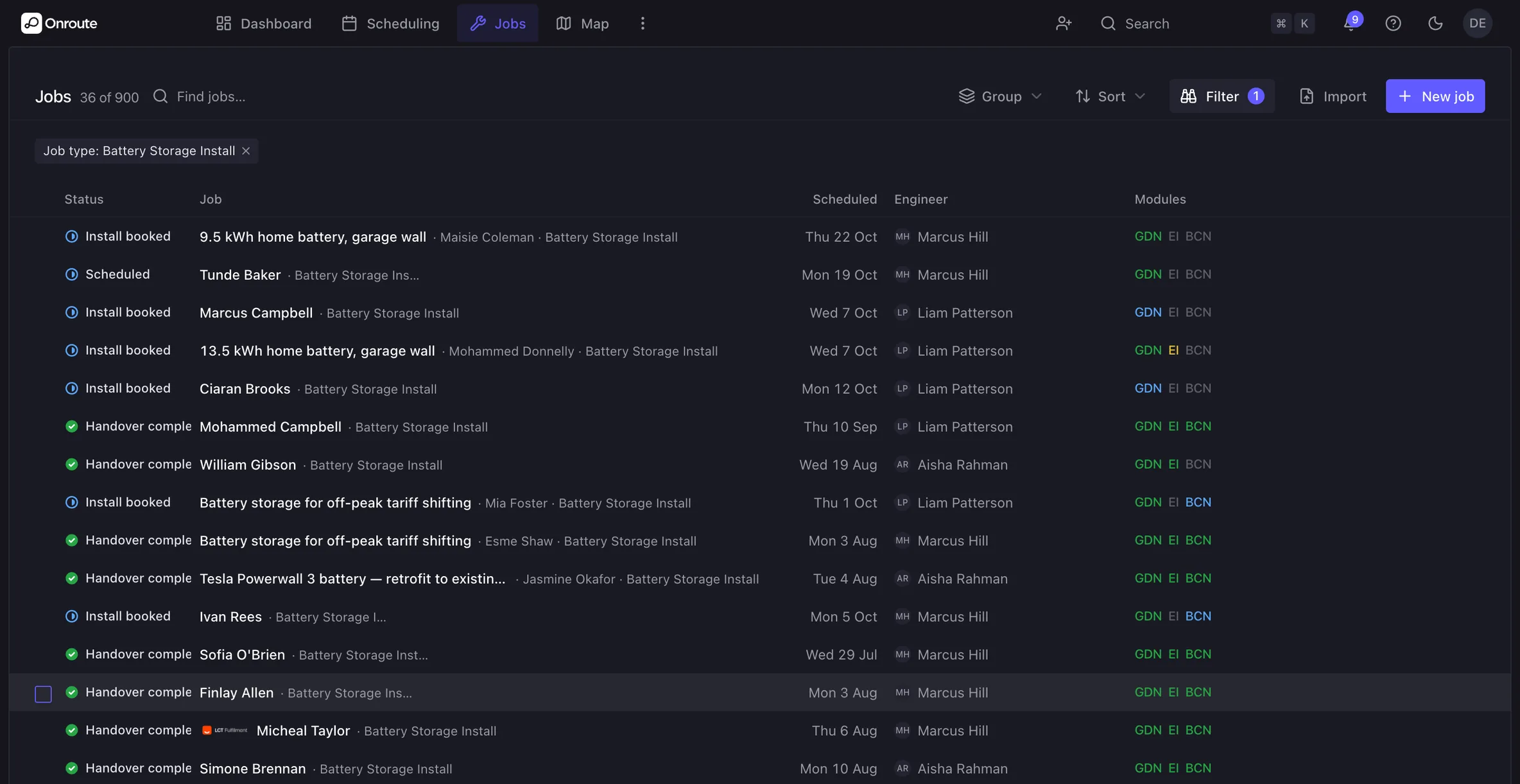
Built around PAS 63100:2024
Battery work now has a named standard. In Onroute the battery job follows PAS 63100:2024 from remote survey to signed-off handover. Each step captures what the standard and the DNO ask for, and the steps that depend on it wait until it's done.
Remote survey
Scope of works
Site assessment
G98 / G99
Installation
EIC
Commissioning
QA sign-off
Handover
Every regulated field carries a plain-English note for the office, and names the rule it satisfies for the engineer signing it.
PAS 63100 site assessments
Location, separation from living spaces, ventilation and mounting recorded with photos — against the standard written for domestic battery installs.
- G98, G99 & G100
- EICs to the current edition
- Commissioning records
- Partner QA, across company lines
- MCS, SEG & TrustMark
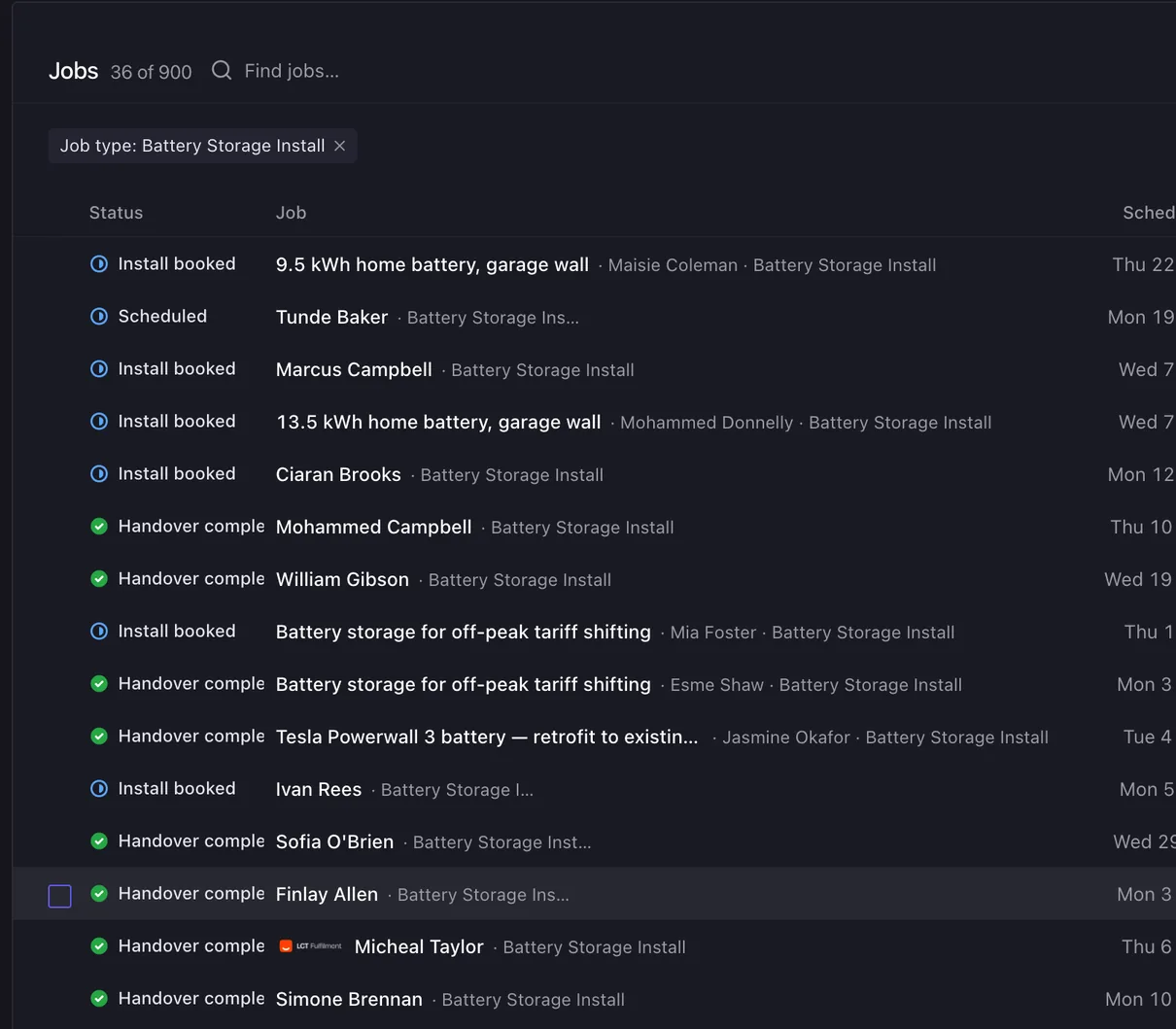
Battery compliance, to the current editions
Battery work carries obligations you can't skip. Every step is written to the current edition of its standard, and a job can't close with one unfinished.
G98, G99 & G100
Onroute picks the right form by system size: G98 notified after connection, G99 approved before the install date, G100 where export is limited.
EICs to the current edition
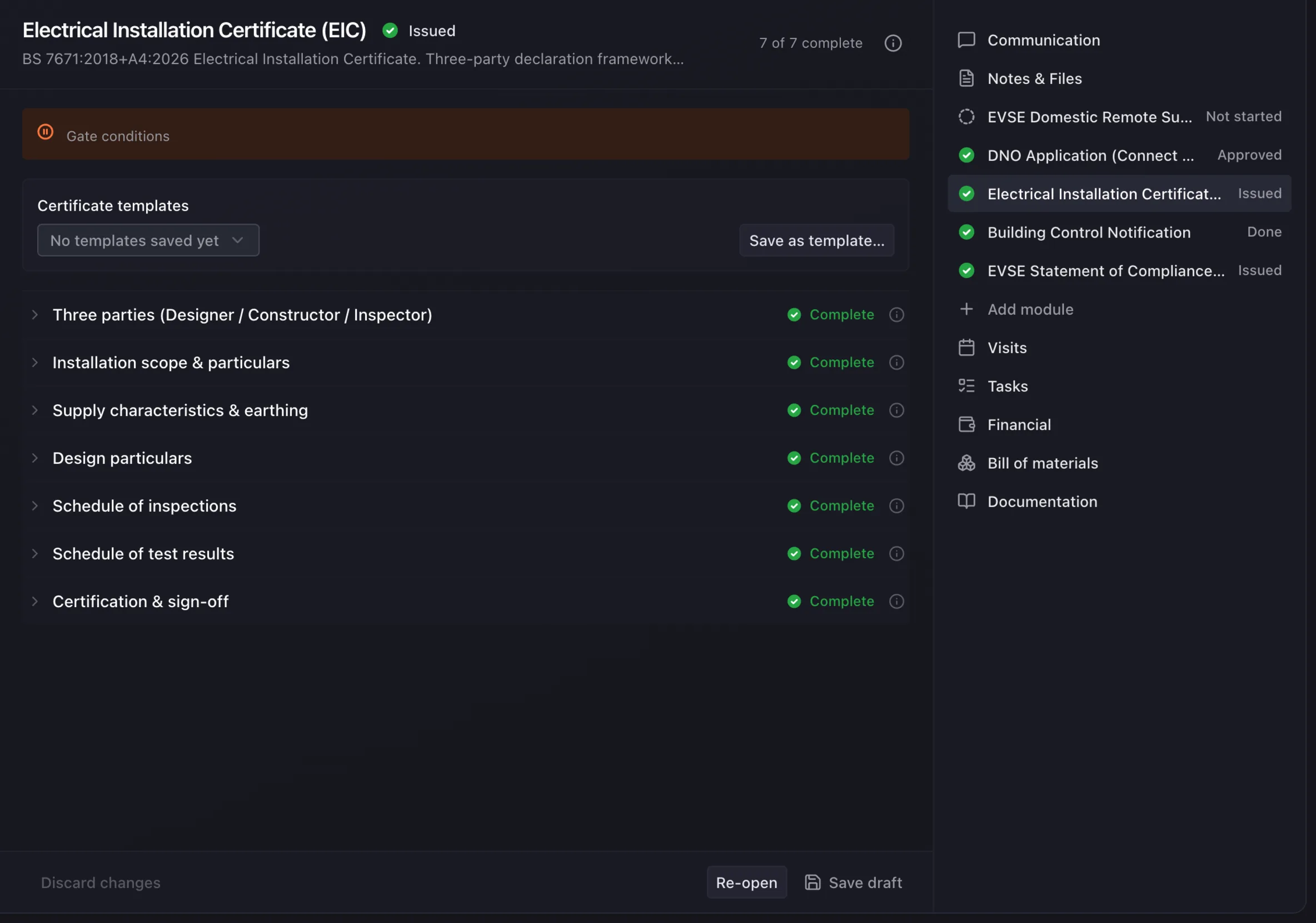
BS 7671:2018+A4:2026, signed on site and sent to the customer as a PDF — with the stationary-battery chapter and the RCD-type detail DC systems demand.
Commissioning records
The loss-of-mains test recorded to the current ENA requirements — a fail blocks the handover pack until it's fixed and re-tested.
Partner QA, across company lines
A partner, or the brand you install for, reviews the evidence pack and passes it, returns it or fails it — from their own Onroute.
MCS, SEG & TrustMark
Coming soonSoon: the certificates that pay out. MCS, SEG and TrustMark each on their own clock, with a warning before any of them runs late.
The compliant path is the only path
Onroute doesn't nudge you towards the right steps. It won't let a job skip them. Where G99 applies, no install date until the DNO has said yes. No certificate is lodged before the work it certifies is signed off, and no job closes with a required step unfinished. Add one step and everything it depends on is added with it, in order.
Features
- No G99 install booked before the DNO says yes
- No certificate lodged before the work it certifies is signed off
- A failed reading holds the EIC
- Every step added, removed or changed is logged, with who and when
Battery on its own, or bolted onto solar
Most batteries arrive alongside a solar job, or onto a roof that already has one. Add a battery to the job and only the extra steps a battery legally needs appear — the DNO and export paperwork you've already done isn't done twice.
Features
- One job for solar and battery — one schedule, one handover
- Shared DNO and export steps done once
- Commercial BESS runs as one multi-visit job: survey, install, commission
- Handover pack with manuals, certificate, commissioning results and warranty registration
Enquiry to handover, hands mostly off
Survey from photos
Start with photos of the fuse board, the meter and where the battery will go. The assessment is under way before an engineer drives out.
The DNO paperwork first
G98 or G99 picked by system size, raised from the job. Where it's G99, the install date waits for the DNO's yes.
Installed and commissioned to standard
PAS 63100 checklist, the EIC signed on site, the loss-of-mains test recorded. All as the work happens.
Signed off and handed over
QA sign-off by your QC or a partner, then the customer's pack lands in their portal.
Questions installers ask
Does Onroute support PAS 63100:2024?
Yes. The battery job is built around it. The site assessment captures, with photos, the location, separation, ventilation and mounting detail the standard asks for, and installation waits on it being done. That evidence carries through to QA sign-off and the customer's handover pack.
When does a battery need G99 rather than G98?
Systems at or below 3.68 kW per phase can usually be notified to the DNO after connection under G98. Anything larger needs a G99 application approved before installation. Onroute picks the form from the system size and holds the install date until a G99 approval is in.
Can I add a battery to an existing solar job?
Yes, and it stays one job. The battery's extra steps join the job in the right order, and one set of DNO paperwork covers both rather than two being raised. One schedule, one handover pack.
Does Onroute handle commercial BESS?
Yes. Commercial BESS runs as one multi-visit job across survey, installation and commissioning, with more than one trade on it. QA sign-off can sit with a partner or the asset owner's own team, and the handover pack is built for an asset owner's or funder's audit.
What goes in the customer's handover pack?
The manufacturer's manual, the signed EIC, commissioning results, the DNO's approval or acknowledgement, warranty registration, safety and emergency information, and the customer's signature to say they've been shown how it works. It's compiled from the job, emailed to the customer and kept in their portal, with every re-issue recorded.
What happens if the loss-of-mains test fails?
Commissioning records the fail, flags it to the office and blocks the handover pack until the fault is fixed and the test passed. The customer can't be handed a pack for a system that failed.
Can a partner or the brand we install for sign off our work?
Yes. QA sign-off is a separate step from installation. It can sit with your own QC, a partner or the brand you install for. Whoever does it reviews the evidence pack and passes it, sends it back or fails it, from their own Onroute. No evidence gets emailed around.